 Broderick Adams
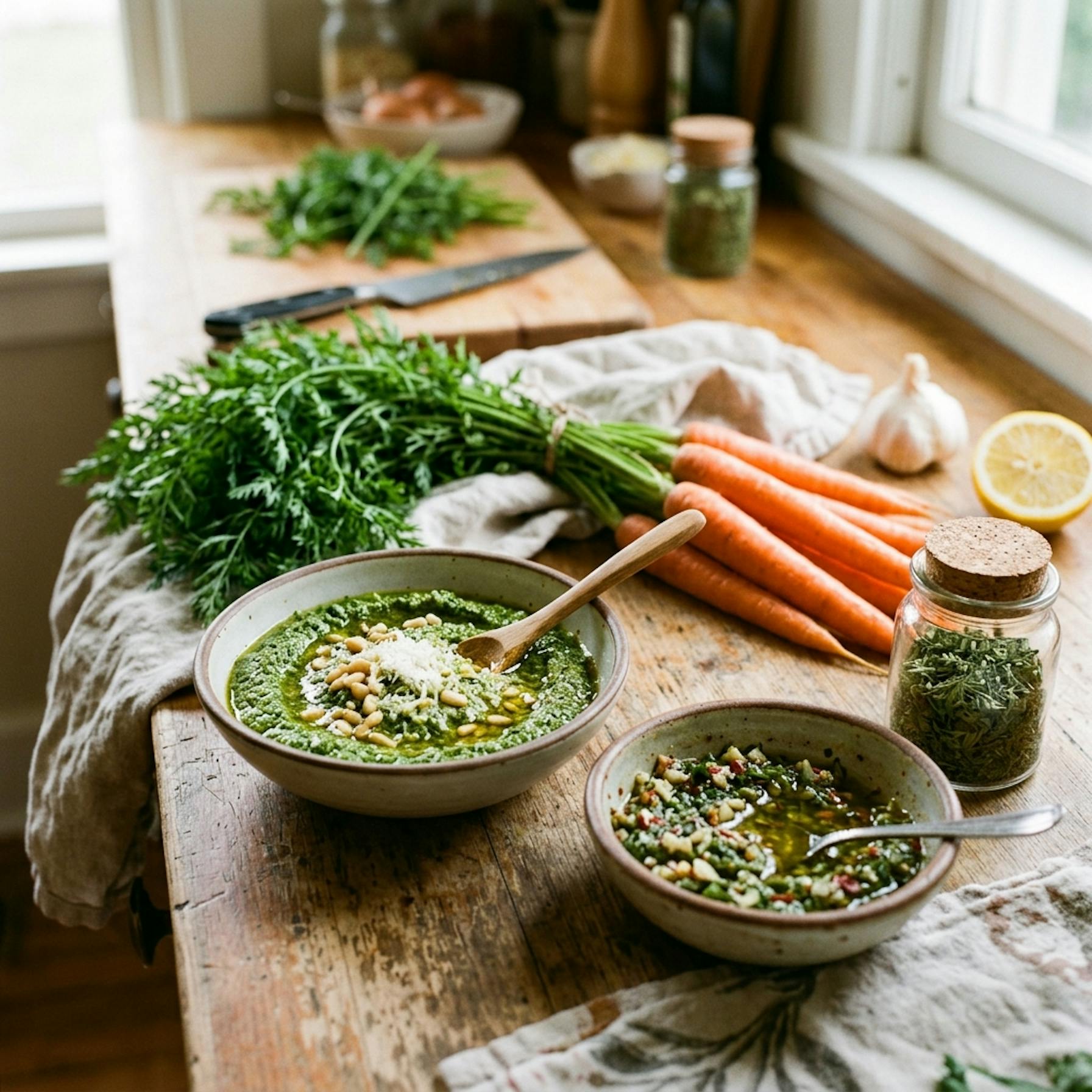
Carrot tops, not the comedian but the often overlooked bonus of your locally grown carrots. If you’ve ever picked up a fresh bunch of carrots from the farmers market — the kind still wearing their feathery green tops like a crown — you’ve probably done what most people do: sliced the greens off and tossed them in the compost (or worse, the trash). It’s a habit worth breaking. Carrot tops or greens are edible, nutritious, and in this week's blog we'd like to share some ideas for how to use them.
This post is part celebration of an underused ingredient, part practical guide. We’ll walk through five great ways to use carrot tops — including a few full recipes — so the next time you bring home a beautiful bunch of carrots, nothing goes to waste.
First Things First: Remove Those Tops Right Away
Before we get into recipes, here’s the single most important tip we can give you: when you get home from the farmers market, remove the carrot tops from the roots immediately.
Those leafy greens are still alive, and they’re actively pulling moisture out of the carrots beneath them. Leave them attached, and within a few days you’ll have limp, sad carrots and wilted greens. Detach them, and both parts last significantly longer.
Store the carrots in a sealed bag or container in the refrigerator (they’ll keep for 1–2 weeks easily). Treat the tops like leafy greens or fresh herbs — wrap them loosely in a damp paper towel inside a zip-top bag, or stand the stems in a glass of water and cover loosely. Use the tops within 2–3 days for best flavor.
For more on storing your farmers market haul, check out our complete guide on how to store fresh vegetables.
What Do Carrot Tops Taste Like?
Carrot tops have a flavor that sits somewhere between parsley and carrot — herbaceous, slightly earthy, with a faint bitterness that mellows beautifully with a little fat, salt, and acid. If you like parsley or cilantro, you’ll like carrot tops. They’re also nutrient-dense, packed with vitamin K, vitamin C, potassium, and chlorophyll.
The key to using them well is treating them like an herb, not a vegetable green. They’re too delicate and too flavorful to be the star of the show in most dishes — but they make an extraordinary supporting player.
Now, let’s get into the five ways we love to put them to work.
1. Dried Carrot Tops (Oven or Dehydrator)
If you can’t use your carrot tops within a few days, drying them is the easiest way to preserve them. Once dried and crumbled, they make a fantastic pantry herb — sprinkle them on roasted vegetables, stir them into soups, or use them anywhere you’d use dried parsley.
Ingredients
- Fresh carrot tops, washed and thoroughly dried
Instructions
- Wash and dry thoroughly. Rinse the tops in cool water and spin or pat them very dry. Excess moisture is the enemy of good drying.
- Strip the leaves. Pull the leafy parts away from the tougher stems. The stems can be saved for stock or composted — you want just the feathery green leaves.
- For the oven: Spread the leaves in a single layer on a parchment-lined baking sheet. Set the oven to its lowest setting (170°F or below) and dry for 1–2 hours, checking every 20 minutes, until the leaves crumble easily between your fingers.
- For a dehydrator: Spread the leaves on dehydrator trays in a single layer. Dry at 95–105°F for 4–8 hours until completely brittle.
- Crumble and store. Once fully dried and cooled, crumble the leaves with your hands or pulse briefly in a spice grinder. Store in an airtight jar away from light and heat. They’ll keep their flavor for up to 6 months.
Use them as you would dried parsley — a teaspoon stirred into a pot of beans, a sprinkle over roasted potatoes, or mixed into homemade seasoning blends.
2. Carrot Top Pesto
This is probably the most popular use for carrot tops, and for good reason — it’s incredible. Carrot top pesto is bright, herbaceous, and has just enough earthy depth to feel a little more interesting than a traditional basil version. Use it on pasta, swirl it into soups, spread it on sandwiches, or spoon it over grilled vegetables.
If you’ve made our radish green pesto before, this follows the same general framework with a few tweaks.
Ingredients
- 2 cups carrot top leaves, packed (stems removed)
- 1/3 cup raw walnuts or pine nuts (almonds work too)
- 2 cloves garlic
- 1/2 cup grated Parmesan cheese — or nutritional yeast for a dairy-free version
- 1/2 cup good olive oil
- Juice of half a lemon
- 1/2 tsp salt, plus more to taste
- Optional: a small handful of fresh basil or parsley to round out the flavor
Instructions
- Toast the nuts. In a dry skillet over medium heat, toast the walnuts or pine nuts for 3–4 minutes until fragrant and lightly golden. Let them cool slightly.
- Blanch the carrot tops (optional but recommended). Drop the leaves into boiling water for 15 seconds, then immediately transfer to an ice bath. Squeeze them dry. This step takes the edge off any bitterness and locks in a vibrant green color.
- Combine. Add the carrot tops, garlic, toasted nuts, Parmesan, lemon juice, and salt to a food processor. Pulse until everything is roughly chopped.
- Stream in the oil. With the processor running, slowly drizzle in the olive oil until the pesto reaches your desired consistency. Taste and adjust salt or lemon as needed.
- Store. Transfer to a jar, top with a thin layer of olive oil to prevent browning, and refrigerate for up to a week. It also freezes beautifully — spoon into ice cube trays for easy single-serving portions.
3. Carrot Top Chimichurri
Chimichurri is the bright, garlicky, vinegary green sauce traditionally served with grilled meats in Argentina — and carrot tops make a brilliant substitution (or addition) to the classic parsley base. This version is sharper and more punchy than pesto, with no cheese or nuts to soften it. It’s the perfect drizzle for grilled steak, roasted vegetables, eggs, or a simple bowl of beans and rice.
Ingredients
- 1 1/2 cups carrot top leaves, finely chopped (stems removed)
- 1/2 cup fresh parsley or cilantro, finely chopped
- 4 cloves garlic, minced
- 1 small shallot, finely minced — or 2 tbsp minced red onion
- 1 tsp dried oregano
- 1/2 tsp red pepper flakes (adjust to taste)
- 1/2 tsp salt
- 1/4 tsp black pepper
- 3 tbsp red wine vinegar
- 1/2 cup good olive oil
Instructions
- Chop everything by hand. Chimichurri is traditionally made with a knife, not a food processor — the texture should be rustic, not pureed. Finely chop the carrot tops, parsley, garlic, and shallot.
- Combine. In a bowl or jar, combine the chopped greens, garlic, shallot, oregano, red pepper flakes, salt, and pepper.
- Add the wet ingredients. Pour in the red wine vinegar and olive oil. Stir well.
- Let it rest. Chimichurri tastes much better after the flavors have had at least 30 minutes to meld. An hour is even better. Taste and adjust salt, vinegar, or heat before serving.
- Store. Refrigerate in a sealed jar for up to 5 days. Bring to room temperature before serving.
4. Sautéed Carrot Tops
Sometimes the simplest preparation is the best one. A quick sauté with garlic and olive oil turns carrot tops into a fast, flavorful side dish — or a great addition to scrambled eggs, grain bowls, or pasta. This is also a perfect way to use tops that are starting to wilt slightly.
Ingredients
- 4 cups carrot top leaves, packed (stems removed)
- 2 tbsp olive oil or butter
- 3 cloves garlic, thinly sliced
- Pinch of red pepper flakes (optional)
- Salt and black pepper to taste
- Squeeze of fresh lemon juice
Instructions
- Prep the tops. Wash thoroughly and dry. Roughly chop the leaves — they’ll cook down significantly.
- Heat the pan. Warm the olive oil or butter in a large skillet over medium heat.
- Bloom the garlic. Add the sliced garlic and red pepper flakes (if using) and cook for about 30 seconds until fragrant — don’t let the garlic brown.
- Add the greens. Toss in the carrot tops and stir to coat with the oil. Sauté for 2–3 minutes until just wilted and tender.
- Finish. Season with salt, pepper, and a squeeze of lemon juice. Serve immediately.
This works beautifully alongside grilled fish, mixed into pasta with a little Parmesan, or piled on toast with a poached egg.
5. Raw, in Salads (As an Add-On)
Our last suggestion isn’t a recipe so much as a permission slip: use carrot tops raw in your salads. Treat them like you would parsley or cilantro — a small handful of finely chopped leaves added to a green salad, grain bowl, or slaw will brighten the whole dish.
They’re especially good with citrus, shaved fennel, white beans, or anything featuring carrots themselves (full-circle eating at its finest). Just chop the leaves finely, skip the tougher stems, and toss them in. A simple lemon-olive oil dressing — or one of our 5 easy salad dressings — lets the flavor shine.
The Bigger Picture
Cooking with carrot tops is a small thing. But it’s also a meaningful one. When you start using parts of vegetables you used to throw away, you stretch the value of every bunch you bring home, you reduce food waste, and you start cooking more intuitively — with what you have, not just what a recipe tells you to use.
That’s the heart of no-waste cooking, and it’s a philosophy we believe in deeply at Emory Market Gardens. The vegetables we grow are raised with care, harvested at peak freshness, and meant to be enjoyed in full — greens, roots, and everything in between.
So next time you bring home a beautiful bunch of carrots, don’t toss those tops. Try one of these five ideas and see how much flavor you’ve been missing.
Made one of these recipes? Have your own favorite use for carrot greens? We’d love to see it — and we always love hearing how you’re using up every part of your produce.