 Broderick Adams
Welcome or welcome back to the blog! Thank you for taking the time to read and I love to hear about the value folks get from reading weekly. It means a lot to us!
Okay let's do an exercise, don't worry we aren't hopping on the treadmill, this will be a mental exercise. Close your eyes and imagine you are eating a fresh, cool, and crisp cucumber. Can you imagine the flavor? Perfect, now that you have that on your mind, let's do the same for a watermelon! Imagine eating your favorite melon on a hot summer day. Okay got that flavor fresh in your mind? Did you know that they exist in the same family AND genus?
This week we dive into the fascinating world of Cucumis—the genus behind cucumbers, melons, and a surprising cast of cousins. From ancient royal gardens to modern greenhouses, this hydrating bulb of botanical wonder has a story as crisp and layered as the slice on your salad plate.
A Brief Vining History
The true birthplace of Cucumis is a tale of two continents. The cucumber (Cucumis sativus) is believed to have originated in India, specifically in the foothills of the Himalayas, where it has been cultivated for at least 3,000 to 4,000 years. Its cousin, the muskmelon (Cucumis melo), traces its roots to Africa and Asia, with wild ancestors still found across the African continent today. Archaeological evidence suggests that humans have been foraging and eating wild members of the Cucumis family for over 10,000 years, making them one of humanity's oldest companions in the garden.
In Ancient Mesopotamia, cucumbers were a prized crop along the fertile banks of the Tigris and Euphrates. The Egyptians cultivated them extensively, and they are referenced in the Bible (Numbers 11:5) as one of the foods the Israelites missed during their exodus from Egypt. The Romans took their love of cucumbers to a whole new level—Emperor Tiberius reportedly demanded cucumbers on his table every single day of the year, prompting Roman gardeners to invent some of the earliest known greenhouse structures (called "specularia") using sheets of selenite to grow them in winter.
By the 9th century, cucumbers had spread to France, and by the 14th century they were a staple in England. Christopher Columbus is credited with bringing cucumbers to the Americas in 1494, planting them in Haiti. Native American tribes quickly adopted and adapted them, integrating cucumbers and melons into their "Three Sisters" companion planting traditions.
Vegetable or Fruit?
Here's a fun bit of botanical trivia: cucumbers, melons, and all members of the Cucumis genus are technically fruits—specifically, they are classified as "pepos," a type of berry with a hard rind and fleshy interior. However, in the culinary world, cucumbers are treated as vegetables due to their savory flavor profile and use in salads and pickling. So the next time someone asks, you can confidently say: botanically a fruit, culinarily a vegetable!
The Diversity of the Genus
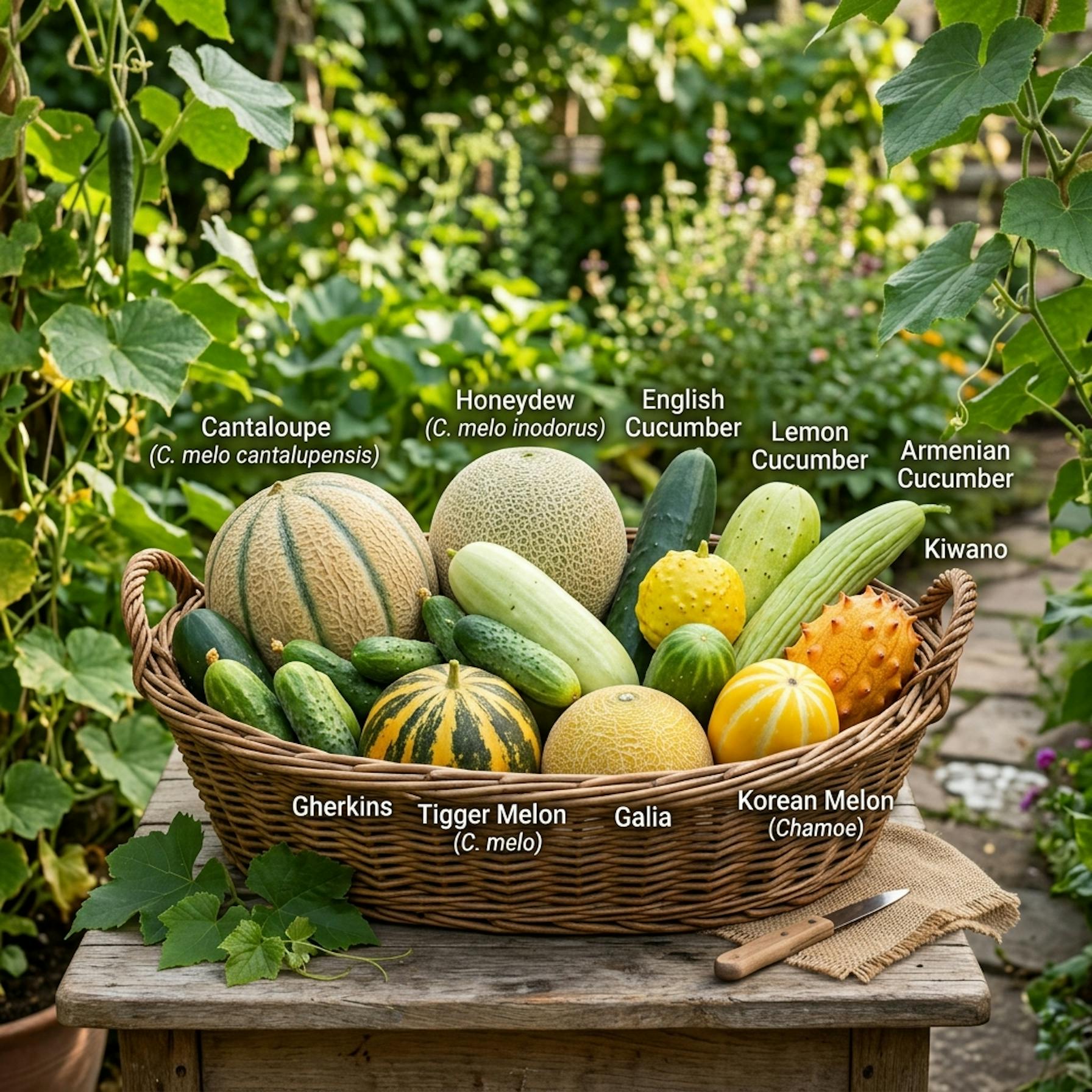
The Cucumis genus contains over 60 recognized species, with centuries of selective breeding producing astonishing variety:
- Cucumis sativus: The common cucumber, including slicing, pickling, and burpless varieties like English, Persian, and Kirby.
- Cucumis melo: A wildly diverse species including cantaloupe, honeydew, casaba, Galia, and Armenian cucumbers (which are actually melons!).
- Cucumis metuliferus: The spiky African horned melon, or "kiwano."
- Cucumis anguria: The West Indian gherkin, a small, bumpy pickling favorite.
Modern breeding has focused on disease resistance, parthenocarpy (seedless fruit production), and adapting plants to greenhouse and hydroponic systems—giving us year-round access to crisp, fresh cucumbers and melons.
Fun Facts About Cucumis
- 96% Water: Cucumbers are one of the most hydrating foods on the planet, made up of roughly 96% water—nature's own sports drink.
- Emperor's Obsession: Roman Emperor Tiberius's daily cucumber demand led to the invention of the world's first greenhouses.
- Ancient Cosmetic: Cleopatra reportedly used cucumbers as part of her beauty regimen, a tradition that survives in spas today.
- Cooler Than the Air: The inside of a cucumber can be up to 20°F cooler than the outside air on a hot day—giving rise to the phrase "cool as a cucumber."
- Global Giants: China produces over 70% of the world's cucumbers, growing more than 70 million metric tons annually.
- A Wedding Gift: In parts of ancient India, cucumbers were exchanged as symbols of fertility and prosperity at weddings.
Nutritional Value
Beyond their refreshing crunch, members of the Cucumis family pack impressive nutritional benefits. They are considered "functional foods," providing health benefits beyond basic nutrition:
- Hydration Hero: With their exceptionally high water content, cucumbers and melons help maintain hydration, electrolyte balance, and skin health.
- Heart Health: Rich in potassium and magnesium, supporting healthy blood pressure and cardiovascular function.
- Antioxidant Power: Contains flavonoids like fisetin and lignans that combat oxidative stress and inflammation.
- Bone Support: A surprising source of Vitamin K, essential for bone health and proper blood clotting.
- Digestive Aid: The combination of fiber and water promotes healthy digestion and regularity.
- Low Calorie: At just 16 calories per cup, cucumbers are a guilt-free snack loaded with vitamins C, K, and B vitamins.
Bonus Recipe: Quick Refrigerator Pickled Cucumbers
This easy recipe transforms a humble cucumber into a tangy, crunchy condiment perfect for sandwiches, salads, or snacking straight from the jar. No canning required!
Ingredients:
- 2 medium cucumbers, thinly sliced (pickling variety)
- 1 cup white vinegar or apple cider vinegar
- 1 cup water
- 2 tbsp sugar
- 1 tbsp kosher salt
- 2 cloves garlic, smashed
- 1 tsp dill seed (or a sprig of fresh dill)
- ½ tsp black peppercorns
- ½ tsp red pepper flakes (optional, for heat)
Instructions:
- Pack: Place cucumber slices, garlic, dill, peppercorns, and red pepper flakes into a clean glass jar.
- Brine: In a small saucepan, combine vinegar, water, sugar, and salt. Heat over medium heat, stirring until the sugar and salt fully dissolve. Do not boil.
- Pour: Carefully pour the warm brine over the cucumbers, ensuring they are fully submerged.
- Cool: Let the jar cool to room temperature before sealing with a lid.
- Chill: Refrigerate for at least 2 hours (overnight is best) before enjoying. Pickles will keep in the fridge for up to 3 weeks.
Stay Connected
Want more kitchen tips, vegetable spotlights, and updates from the garden?
Let us know—what "rabbit hole" vegetable should we feature in our next blog? We love hearing from our community!