 Broderick Adams
Have you ever thought about a mushroom remembering something? I have to say, me either until I read a fascinating study. This week we dive into the wonderfully weird world of fungal computing, and specifically a line of research exploring mushrooms as memristors. A memristor is a tiny electronic component that "remembers" the electricity that has passed through it.
The History of the Memristor
To appreciate why mushrooms enter this story, it helps to know a bit about the memristor itself. In 1971, an electrical engineer named Leon Chua at the University of California, Berkeley, proposed that a fourth basic circuit element was missing from the textbooks. We already had the resistor, the capacitor, and the inductor. Chua argued there should be a fourth, a "memory resistor," whose resistance depends on how much current has flowed through it in the past. Turn the power off, and it holds on to that state.
For decades the memristor was mostly a theoretical curiosity. Then in 2008, researchers at HP Labs announced they had built one out of titanium dioxide, and interest took off. Memristors are exciting because they behave a little like the synapses in our brains. Synapses strengthen or weaken depending on how often they're used, which is part of how we learn and remember. A computer chip built from memristors could, in theory, store and process information in the same place, much like a brain does, instead of shuttling data back and forth the way conventional computers do. This field is called neuromorphic computing, and it's one of the big frontiers in computer science right now.
The catch? Most memristors are built from materials that require mining, energy-intensive manufacturing, and rare elements. That's where our fungal friends come in.
Enter the Mushroom
Here's the part that made me put my coffee down. Researchers have been quietly exploring fungi as electrical materials for years. Andrew Adamatzky and his colleagues at the Unconventional Computing Laboratory at the University of the West of England have been studying the electrical activity of fungi for over a decade. Their work has shown that fungal mycelium, the threadlike network that lives underground or inside a log, produces spikes of electrical activity, and in 2021 his team published findings that the fruiting bodies of oyster mushrooms displayed memristor-like behavior.
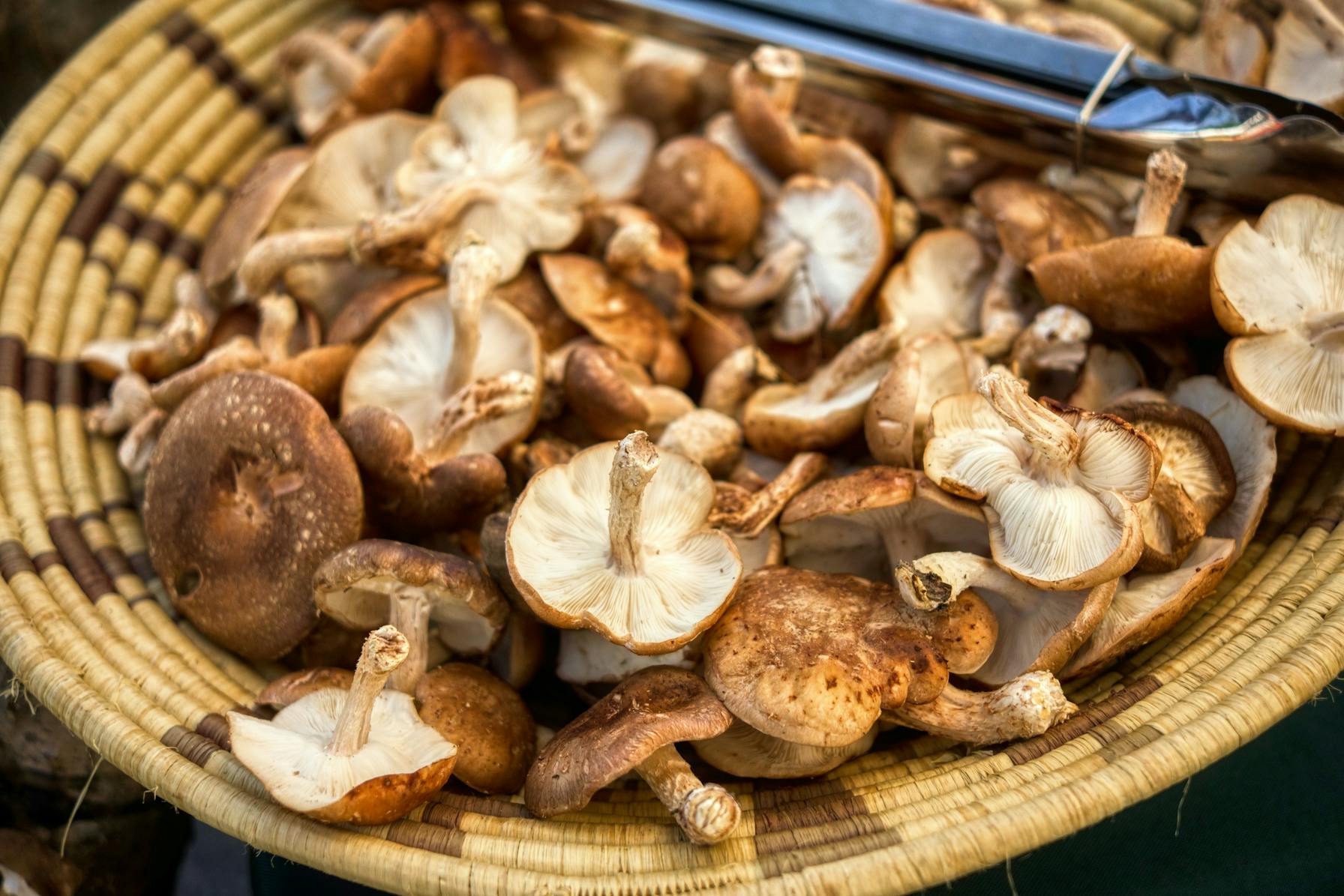
In 2025, a team at The Ohio State University led by John LaRocco took the idea further. They grew shiitake and button mushroom mycelium, dried the cultures to preserve them, and then wired them up with electrodes. When they sent electrical signals through the fungal material, it behaved like a memristor, switching between electrical states and holding onto them. Their shiitake-based devices were even able to function as a kind of memory, switching thousands of times per second with roughly 90 percent accuracy. Performance dropped off at higher speeds, but the researchers found that linking multiple mushrooms together helped make up for it, a bit like how neurons work together in a network.
The work was published in the journal PLOS ONE, and I'll admit I read it twice to make sure I had it right. Mushrooms. Remembering things.
Why Shiitake, of All Things?
Shiitake turned out to be a great candidate for a few very practical reasons, and as a grower, they made me nod along. Shiitake mycelium is tough and resilient. It holds up well to being dried out and can be rehydrated, and the dehydrated samples stayed usable over time. It's also easy and inexpensive to grow. You don't need a clean room or a mine, just substrate, spores, patience, and the right conditions, which anyone who has spent a humid afternoon soaking logs can tell you about.
There's also something poetic about it. Mycelium is, by nature, a network. It spreads through soil and wood, connects to plant roots, and moves nutrients and signals across remarkable distances. Some folks call it the "wood wide web." It makes a certain kind of sense that a living network could be coaxed into acting like an electronic one.
What It Means (and What It Doesn't)
Before anyone starts planning to swap out their laptop for a your shiitake log, let's keep our feet on the ground. This research is early. Fungal memristors are far slower and larger than the silicon chips in your phone, and they're not going to replace conventional computers anytime soon. What they offer instead is a glimpse at a different kind of technology, one that could be:
- Biodegradable: At the end of its life, a mushroom-based component could break down rather than piling up as electronic waste.
- Low Cost: Growing mycelium is cheap compared to fabricating semiconductor materials.
- Low Energy: Brain-inspired computing promises big energy savings, and fungal materials could be one gentle path toward it.
- Sustainable: No rare earth mining, no toxic manufacturing byproducts, just biology doing what biology does.
- Useful in Unexpected Places: Researchers have floated ideas like environmental sensors, edge computing devices, and even applications in aerospace, where lightweight, radiation-resilient materials are valuable.
It's worth noting this isn't the only place fungi are showing up in the tech world. In 2024, researchers at Cornell University used the electrical signals of king oyster mushroom mycelium to help control small robots, letting the fungus "sense" light and steer movement. It feels like every year brings a new surprise from the fungal kingdom.
Fun Facts About Mushrooms and Mycelium
- The Real Organism Is Underground: The mushroom you eat is just the fruiting body. The main organism is the mycelium, a vast web of threads called hyphae.
- Closer to Us Than to Plants: Genetically speaking, fungi are more closely related to animals than they are to plants.
- Electric Chatter: Fungi produce spikes of electrical activity, and some researchers have compared the patterns to a kind of signaling, though what it all means is still very much up for debate.
- A Missing Piece for Decades: The memristor was predicted in 1971 but wasn't built as a physical device until 2008.
- Enormous Networks: One honey fungus in Oregon's Blue Mountains spreads across more than three square miles, making it one of the largest living organisms on Earth.
- Ancient Cultivation: Shiitake have been cultivated on logs in China and Japan for roughly a thousand years, and our backyard method isn't all that different.
- Mycelium Everywhere: Beyond computing, mycelium is being explored for packaging, building materials, leather alternatives, and insulation.
Why I Keep Thinking About This One
So much of the natural world is still full of surprises we haven't even begun to understand, and sometimes the most futuristic ideas start with something as ordinary as a mushroom growing quietly in the shade.
I hope you enjoyed a brief look at these mycelial developments as much as I did researching it!
Stay Connected
Want more kitchen tips, vegetable spotlights, and updates from the garden?